




Adam Liebman is a PhD candidate in sociocultural anthropology at the University of California, Davis. From 2013 to 2015 he conducted research in Kunming in support of his doctoral dissertation, which is concerned primarily with something we all tend to spend too little time contemplating — garbage.
Does a day go by when those of us living in the Spring City don't see an octogenarian searching through the trash for plastic bottles? What is the motivation, and where does all of the 'picked' refuse end up? These are questions we at GoKunming have always pondered but never answered. So, for the past several months, we zapped Liebman a series of questions regarding his work and findings and he was kind enough to provide us with some eye-opening answers.

GoKunming: Could you start by explaining the basics of your research, including your overall focus, methodology...basically everything?
Adam Liebman: My research interests are quite broad, but generally are focused on everyday waste politics in contemporary China — I use this as a lens to think through some conceptual issues related to materiality, value, labor, care and crises. In terms of methodology, I informally interviewed over 100 people who are involved with scrap trading in Kunming.
This included garbage pickers who search for discarded objects of value in public spaces and waste bins, and then small scale scrap buyers who typically buy goods directly from urban residents, workers, and small businesses and transport their goods with bicycle-drawn carts. Next were larger scale scrap buyers who typically rent out old shop spaces or warehouses where the rents are cheapest, and finally an assortment of others including sanitation workers, longtime Kunming residents, scrap trading market managers and entrepreneurs trying to reform and monopolize the industry.
GK: Outside of the interviews, did you get personally involved?
Liebman: The interviews provide a foundation for my dissertation, but anthropologists also emphasize 'participant observation', which for me meant making friends with some of the interviewees, joining them in the labor of scrap trading, and joining them for the meals and drinks that sometimes followed — and sometimes preceded — a big job. I also spent time with a few NGO-type organizations who are involved with waste-related issues. Overall, I spent about one and a half years doing field research.
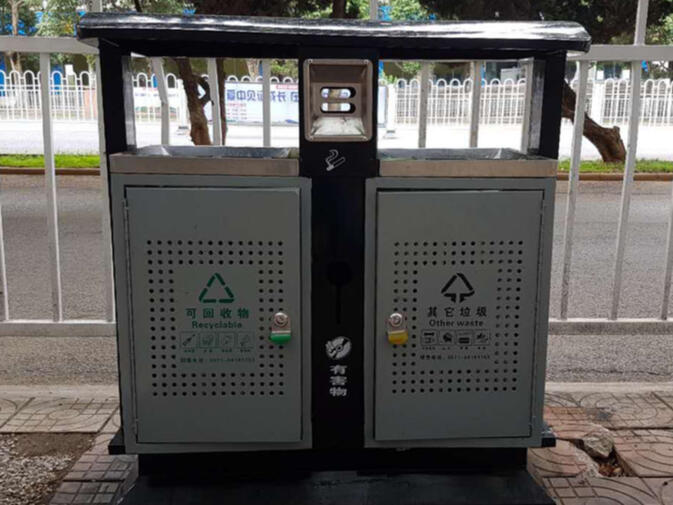
GK: What happens from the point I see a homeless person or a retired grandmother digging through my neighborhood dumpster?
Liebman: I'll try my best to give a short answer here. There are two kinds of 'waste management' systems that exist in Kunming, as is the case in all Chinese cities to my knowledge. The local government takes responsibility for garbage collection — processing, and disposal — and it also invests a lot of resources into public service messages which urge city residents to dispose of waste properly. However, it does very little, if any, waste sorting or what you probably think of as recycling.
Although the majority of garbage bins seen in public spaces have two sides — one for "recyclables" and the other for "non-recyclables" — and some residential areas even have four or more separate bins to ostensibly encourage waste sorting and recycling, there is no formal recycling system connected to these bins. When city sanitation workers come around to collect garbage, contents from all of the bins are dumped together.
The workers who deal with the bins may pick out some of the objects which they can sell as scrap, but by this point a lot of potential items are too dirty for them to bother. Oily, rotting food waste pollutes paper and other kinds of scrap, while the food waste, which could be used for compost, biogas, or feeding pigs, generally has too much other stuff mixed in with it to be of use.
This does not mean, however, that there is no recycling happening in Kunming. Although overall it is a declining practice, many older residents still meticulously save and sort all of their everyday waste which can be sold, including paper, plastics, glass, metals, old furniture and appliances. Some of these older residents — "retired grandmas" as you put it — also habitually roam around streets, alleys, and parks in search of discarded objects of value. Other garbage pickers, it should be emphasized, have worse situations and indeed rely on picking as a livelihood.

GK: And this is how some discarded objects end up within the scrap trading industry?
Liebman: Yes. Habits of thrift and attention to the material properties of objects are crucial, as is sorting. The more meticulous the sorting, the higher the scrap market values. For example, thick cardboard without added color goes for the highest price, while keeping different brands of beer bottles separate provides higher prices than does mixed glass. These goods are sold to scrap buyers, who do the labor of further sorting, breaking down, packaging, and finally transporting to either larger scale buyers or directly to factories.
They are thus essentially middle-buyers who make money by selling for slightly higher prices than they buy. The larger scale buyers often specialize in one or two types of goods, and they often own specialized machines and hire a few workers to help them transform these goods into raw materials for industrial production. Some goods end up in factories in or around Kunming, while others end up as far away as Guangdong, Zhejiang, or even northeast China. This depends on demand, market conditions and personal connections.
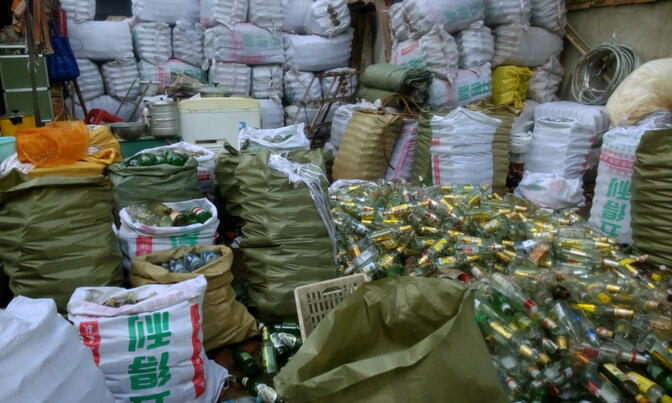
GK: What about the waste which does not get sorted and instead ends up in the local government's waste management system?
Liebman: The main thing that makes sanitation workers different from informal pickers or buyers is that they are paid a wage by the government. Their job is to remove garbage and keep the city clean. There are garbage transfer stations located all over the city where garbage from the various carts and motorized vehicles used by sanitation workers is consolidated and then loaded into larger trucks. These trucks then transport the garbage outside of the city to relatively new incineration plants — a waste management trend which is highly contested across China.
The Kunming government has approved the construction of five incineration plants, which burn garbage to produce electricity, but also generate dioxins and highly toxic fly and bottom ash. The city's previous landfills are now closed and, according to the city, 100 percent of Kunming's garbage is incinerated. At this point, there is actually not enough garbage to satisfy the needs of all five incineration plants.
This is because the plants rely on garbage as a raw material to produce electricity, and only by selling electricity on the market — in addition to collecting a portion of the garbage fees paid by urban residents — will they be able to eventually recoup their investments and start making profits. This situation, in effect, puts the incineration coalition at odds with any attempts to promote recycling since successful recycling programs reduce the overall amount of garbage left for landfills and incinerators.

GK: Does the city government support the scrap trade?
Liebman: Mostly no. While the city has invested in incineration as its primary waste management strategy, it has also tried to crack down on the informal scrap trade. Although it is possible for some people to get business licenses for trading scrap, much of the trade is conducted informally and in a legal grey area. Different government bureaus have different reasons for not supporting the trade.
The Transportation Bureau fines and sometimes impounds unauthorized bicycle-drawn carts found within the Second Ring Road for disrupting traffic. The Urban Management Bureau harasses those whose businesses spill into public space and the police harass people for not having permits and for dealing in stolen goods. Many larger scale scrap trading markets, which are often managed by the remnants of state-owned Mao era recycling companies, are bring pushed further and further out of the city because they are said to be polluting and to negatively affect urban aesthetics.
In short, the informal scrap trade is generally not seen by the authorities as having a positive effect on the environment, but rather is seen as a polluting, disorderly, backward, and thus undesirable industry. The main reasons for this are that the scrap trade is run almost entirely by rural migrants who often face discrimination in cities, and because unregulated industrial processing of scrap can indeed be very polluting and harmful to the environment. When plastics are processed, for example, they must be washed in chemical baths to get rid of food residue. When these chemical baths are dumped directly into surface water, the pollution is very serious indeed.

GK: Did you look into the health effects of being a waste picker or processor?
Liebman: Most serious health effects would be experienced by those engaged in unregulated large-scale processing, especially those who deal with plastic, car batteries, or e-waste. For those who are at lower levels of the trade, such as the pickers and small-scale buyers which my study mostly focuses on, the health effects seem to be no worse than they would be for others engaged in labor intensive jobs.
It is definitely hard and dirty work though. Many pickers wear masks, gloves, and use long clippers for protection. But many do not. I've helped with some of the labor that scrap traders do and I can attest that dealing with scrap means breathing in a lot of dust. As scrap consolidates it also, not surprisingly, becomes extremely heavy — especially paper. Many older scrap traders have back problems and say that their bodies have been severely worn down from plying the trade.

GK: How much can a migrant working as a full time 'picker' expect to make in a day or week?
Liebman: In terms of income, it's highly variable. Some of the older pickers who work leisurely for no more than a few hours per day make just one or two yuan per day. A more serious picker who spends most of the day searching for scrap could make more than ten yuan per day. I met one young picker who claimed to make 60 yuan a day, but I'm pretty sure he was exaggerating. I somehow got in the habit of checking for, and yes, picking, a bit of available scrap myself while walking through the streets of the city. It's hard for me to imagine how hard one would have to work and how much ground one would have to cover to even make ten yuan on a daily basis.
The numbers are also highly variable for scrap traders. Between 2,000 and 3,000 yuan per month seems to be about average. But there are certainly some traders who have really good spots, good connections or just good luck. Some have done quite well and have been able to buy nice cars and one or more homes in Kunming — the standard material markers of success. But this is rare.
I should also note that scrap prices are constantly fluctuating in response to global economic trends. When I was doing my fieldwork, prices were very low. Record low commodity prices for oil, for example — and plastic comes from oil so this made virgin plastic cheaper — really affected the industry. Combined with rising rents and other living costs in the city, this pushed some scrap traders out of the business. But in 2017 prices are finally bouncing back a bit.

GK: Do you have an idea of how much of Kunming's — or China's — waste is recycled?
Liebman: There are some statistics of this nature out there, but I don't trust them very much. The amount of waste produced in China has clearly increased dramatically in the past decades since reform and opening. I often get the comment that I shouldn't focus so much on municipal solid waste, because actually industrial waste is a much larger and more serious environmental threat. In response I often cite the numbers 24,000 and 70,000 as two estimates I've encountered of the number of people who make their living trading scrap in Kunming, and I point out that this is not strictly an environmental study but rather an anthropological one. The large number of people who are living off of scrap to me makes this a very worthwhile study, and Kunming hosts a particularly large population of scrap traders.
In terms of how much waste is getting recycled, it is very hard to say, because so much of the 'recycling' is happening outside of the formal economy, and because it is up for debate whether or not the informal scrap trade should even be considered a recycling system. Incineration plants, for example, often publicize themselves as being green and using garbage as a renewable resource. That's a highly debatable notion.

GK: Do you have any particularly interesting, touching or shocking anecdotes from your fieldwork?
Liebman: Too many to tell! One thing that people always wonder is whether some kind of mafia is involved in the business. For the lower levels of the trade, the answer is no. It's more of a frontier-like free-for-all. On the higher levels, I did hear about some shady stuff. For example, one woman whose family specialized in trading scrap told me about a guy from Guangdong who showed up at the scrap market looking to buy tens of millions of yuan worth of copper — the most valuable type of scrap.
Most traders at the market thought he seemed really suspicious and they didn't want to deal with him, but the woman's cousin decided to take a chance and make a deal with him. Apparently after making the deal the guy managed to get all of the copper loaded up and moved out of there without actually paying. So the family had to follow him down to Guangdong and threaten him. It turned out that the guy had such a large gambling debt that his life had been threatened, and he'd sold the copper immediately to repay part of his debt. So the family ended up stealing his two cars and driving them back to Kunming as the only means of partially compensating their loss. Of course, I have no idea how accurate this story is, but it was interesting to hear these kinds of tales circulating through the trade.

Images: Adam Liebman
© Copyright 2005-2026 GoKunming.com all rights reserved. This material may not be republished, rewritten or redistributed without permission.


Comments
"A more serious picker who spends most of the day searching for scrap could make more than ten yuan per day"
Always wondered how much these people make, knew it would be low but still thought it'd be a little higher than that :(
Makes that Starbucks coffee feel even more of a waste of money than ever before and it's always felt like a waste!
Great article. Thanks!
I read somewhere that many garbage pickers in Kunming are not just rural migrants to the city, but tend to be from particular ethnic minority groups - any truth to this?
Excellent interview. Does anyone know how I pay for my garbage collection? I pay a monthly wuguan fee, but don't assume it covers the city guy dumping the bins into his cart. Maybe the xiaoqu is levied a waste fee?
"A more serious picker who spends most of the day searching for scrap could make more than ten yuan per day"
This is why, when I'm doing spring cleaning or otherwise getting rid of a lot of scrap, I just give it to them for free. My neighbors think I'm crazy.
AlexKMG: It's probably included in your wuguan fee. A lot of neighborhoods don't bother giving residents an itemized list, but if you ever see one, you'll see it's divvied up into things like grounds maintenance, elevator inspection fee, security, waste removal and whatnot.
If you pay your water bill to your wuguan instead of directly to the utility company, it is sometimes bundled into that bill.
Fascinating. Does anyone know where the incineration plants are and what kind of technology they're using? The level and type of pollution generated can widely a great deal.
I'd also be very surprised if they really were incinerating 100% of the rubbish collected by the authorities.
thanks for that!
@Andrew.
No idea what type of technology they use but you can recognise them on the chimney and cooling towers (Painted in happy floral designs).
The Wuhua one is in the far northwest of the city near the motorway junction of the third ring road and the motorway to Fuming.
The Xishan one is behind Xishan Mountain and nearer to Haikou then Kunming.
Wuhua N25-06-59 E102-39-31
Xishan N24-50-56 E102-32-25
Fascinating article. Thanks.
really interesting stuff, good job
This was interesting indeed.
I would also link this to another topic recently covered on this site, which is a central government team's visit to check whether Kunming now could be considered a "civilized city".
Lot of posts about this have appeared around the city in recent weeks, apparently trying to sell the idea to the general public.
Couple of weeks ago in our neihbourhood we spotted a group of people, who we suspected part of this investigation group, and one thing that they did outside our house was looking in the rubbish bins.
I noted that they pointed out how both "recyclable" and "non-recyclable" bins contained mixed waste. Also when they left the scene, one of the sanitation workers grumped, as if the group had just messed up her work.
So even if rubbish in both of the bins ends up to same place when collected (according to this article anyway), it seemed to be a factor in determining Kunming's "civilized" status that residents should sort their waste properly to correct bins.
@Janjal
The separated waste collection bins in the street indeed get collected in one single bin on a collection vehicle.
The old one even had one entry for batteries; since there was nothing behind it to collect things thrown through there they just fell on the ground.
Clear example of the conflict between idea and practice.
How can refuse pickers (or anyone in Kunming) survive on about 10RMB a day? Where do they live? What do they eat?
@ocean, I believe they live in structures built from the refuse they collected and eat what they find in the rubbish bin.
The money they saved goes toward buying the latest iPhone. It's only two and a half month's work.
"A harmonious society".
does anybody know how these trash pickers are called in chinese?
Despite all the city water Alien had a good question. Could they be Yi? Thats a broad definition aint it.
There was a guy several years ago, working as a waiter around Jinma area, who one day said "he is from a minority that doesnt exist", "very small" etc. (Had not been recognized). And typically you had to fish out as much as possible, bcs it was his half secret. And if you were working in this Jinma area, you didnt want to be known to belong to a 'backward group'. (And this is very common, you can know people who say they are 'kunming ren' for years until its revealed they are from a Lahu village in Lincang.)
Anyway, he spoke the language of the beggar women at Jinma square, who looked like they came from a Yunnan/Guizhou mountain.
>>"does anybody know how these trash pickers are called in chinese?"
It's 收废品 for the people who ride around on the 3-wheel bikes 三轮车 and collect broken appliances. I'm not sure of the term for the smaller-scale "dumpster divers."
""does anybody know how these trash pickers are called in chinese?""
I believe the lower level ones are called 拾荒者 (shihuangzhe).
we used to call them 丁当 dingdang, because of the bell or saucepan lid tied to the handlebars they rang or banged
@puddleofmark "拾荒者" seems to be the most respectful title to use.
Login to comment